
From Zero Online Presence to 29,600 Impressions in 1 Month
By Istiak Ahmed Soikot, Founder and CEO, Rank OG.
Last reviewed: November 2026.

This business SEO case study starts with a client that did not exist on Google one month ago. Not on page ten, not buried in the results, not anywhere. Today the latest Search Console view shows 91 clicks and 29,600 impressions.
This business SEO case study tells the story the way it happened: no shortcuts, no overnight success, no inflated claims. A business that did not exist online, one month of steady work, and the first real numbers to show for it. If your business is hard to find online, this is what the first month of fixing that looks like.
Key takeaways
- The client started with zero online presence: no Google visibility, no pages ranking, nothing for customers to find.
- One month of work in this business SEO case study: clean on-page SEO, technical fixes, and content written for real search intent, optimized for Google and AI search.
- The first numbers: 91 clicks and 29,600 impressions, a 0.3 percent click-through rate, and a 34.6 average position.
- Growth is gradual and steady, with impressions climbing a little higher every week.
- The numbers are early, and that is the honest point: the foundation is in place, and the headroom ahead is large.
Where did this website start?
It started with nothing to find. One month ago, this client had no visibility on Google at all: no pages ranking, no search footprint, no way for a customer to discover it through search.
The business existed in the real world, but online it was invisible. When people searched for what it offers, nothing belonging to it appeared. That starting point shapes everything in this business SEO case study, because every number that follows is measured against zero.
That costs more than most owners think. Customers search first and decide second. A business that does not appear in search is simply not part of that decision, no matter how good its work is offline. Every search that should have found this business found a competitor instead. That is the quiet cost of being invisible: customers who never knew you existed.
It is also a harder starting point than a poorly ranking website, which still has pages Google knows about. A business with no online presence starts without that base, and every part of the visibility has to be earned from the beginning. For a business that serves customers in one area, that gap is felt first in local search, which is why local SEO is often where the first visibility is won or lost.
What did Rank OG do?
Rank OG spent the month building a foundation worth ranking for the client in this business SEO case study: a site clear about what it offers, easy for search engines to read, and useful to the people who search.
The work followed the same approach Rank OG uses for clients: clean on-page SEO, technical fixes, and content written for real search intent, optimized for Google and AI search. Each page says clearly what it is about, so Google can match it to the searches people actually make. Technical SEO removes the barriers that stop search engines reading a site properly. And the content answers the questions people are already asking, instead of chasing keywords.
When a business starts from zero, the order of the work matters more than the speed of it. The site has to be clear about what it offers, easy for search engines to read, and genuinely useful to the people who search. None of that is glamorous, and none of it works overnight. But it is the work that makes the rest possible. A site that is clear, readable, and genuinely useful is a site Google can start showing. The first month was spent building that, before expecting rankings.
The AI search side was part of the same month, not a separate job. More people now get answers from ChatGPT, Perplexity, Gemini, and Google AI Overviews instead of clicking through a list of links. Content that is clear, factual, and written for real questions is the kind of content those systems can cite. That is what AI search optimization, answer engine optimization, and generative engine optimization all come down to here: clear pages that answer real questions.
What happened in one month?
One month of work took the site in this business SEO case study from invisible to seen 29,600 times, with 91 clicks. The growth did not arrive at once. It built week by week, and the latest weeks are strongest.
The screenshot below is the latest three-month view from Google Search Console: 91 total clicks, 29.6K total impressions, a 0.3 percent average click-through rate, and a 34.6 average position. Read it with one detail in mind: the view covers three months, but the SEO work covers one month. The early part of the chart is almost flat, because that is the period before the work began, and the growth belongs to the later weeks.
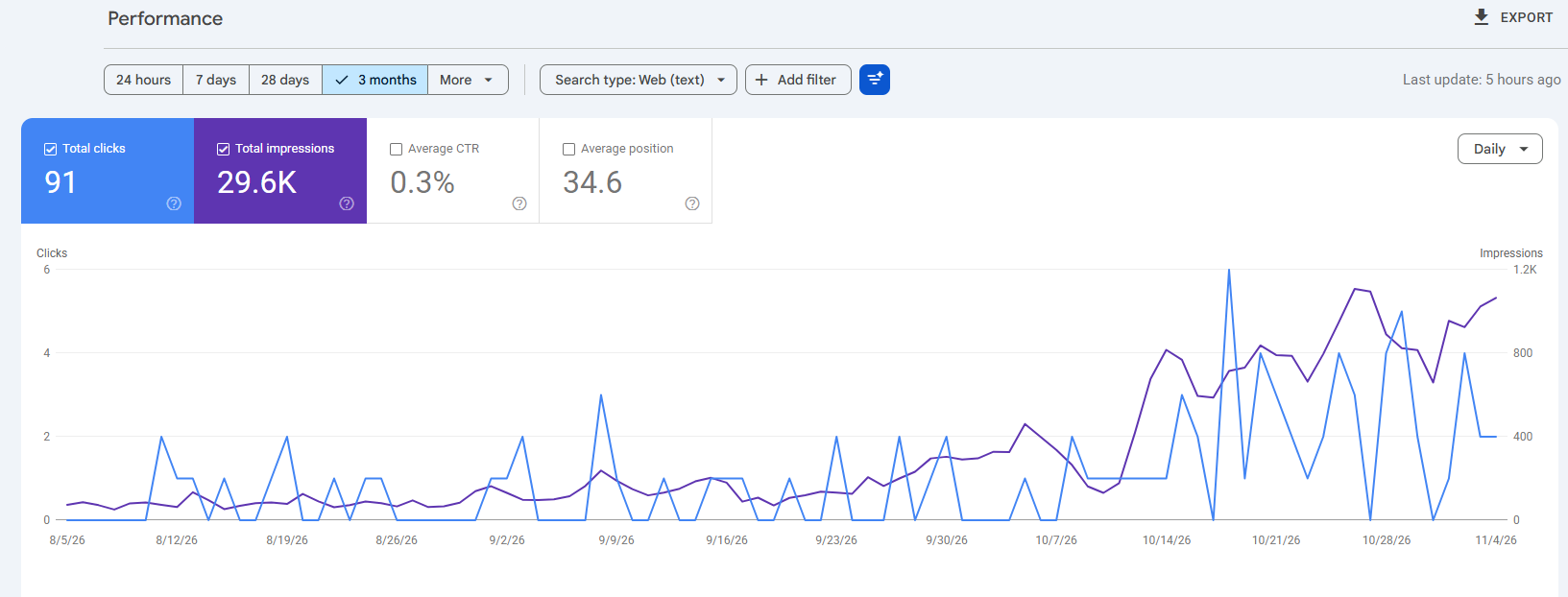
The shape of the impressions line tells the story. It starts near zero and stays there for most of the early period. Then it begins to climb, a little higher each week, and the climb gets steeper in the final weeks. That is what gradual growth looks like: not a sudden jump, but a line that keeps rising as the site earns more visibility.
Clicks are still small, and the chart shows that honestly. Most days bring zero, one, or two clicks, with a few higher days scattered through the later weeks. That is exactly what to expect at an average position of 34.6, because most of the site’s appearances are still on later pages of results. Impressions are the leading signal here. Clicks are the lagging one. The screenshot is the proof at the center of this business SEO case study, and it is worth reading for what it does not claim as much as for what it does.
What does the before and after look like?
The table below sums up this business SEO case study in four rows. Before the work, there was nothing to measure. After one month, there are real numbers, and they are early.
| Metric | Before | After one month |
|---|---|---|
| Clicks from Google Search | 0 | 91 |
| Impressions on Google Search | 0 | 29,600 |
| Average click-through rate | No data to measure | 0.3% |
| Average position | Not ranked | 34.6 |
Read the table as a beginning, not a result to celebrate. The after column is real progress from zero, and it is also a long way from the first page. The honest verdict: the foundation works, and the work ahead is to turn impressions into clicks and clicks into customers.
What does a 0.3% click-through rate mean for this client?
It means about 3 out of every 1,000 times Google showed the site, someone clicked. That sounds low, and it is low. But at an average position of 34.6, it is also exactly what to expect.
A click-through rate is simply clicks divided by impressions. Google’s Search Console Help explains the same calculation: 91 clicks divided by 29,600 impressions is 0.3 percent. The rate is low because of where the site appears, not because the pages are failing. Most appearances are on later pages, where few people look, so few people click.
The rate should rise as the average position improves, because more appearances on the first page means more people see the site where they actually look. Watch it month by month, next to the position, not on its own.
What does an average position of 34.6 mean for this client?
It means the site mostly appears around the fourth page of Google results. Positions 1 to 10 fill the first page, so 34.6 sits well past where most people stop looking.
An average position is an average across every search where the site appeared, so 34.6 is the middle of a spread, with some searches higher and some lower. That is normal for the site in this business SEO case study, one month into its first visibility. What matters most is the direction that number moves over the next months, because a rising position turns impressions into clicks.
Impressions are the leading signal here, and the average position explains why. The site is being shown 29,600 times, which means Google trusts it enough to show it. Clicks are the lagging signal, and they will stay small until the position climbs onto the first page. That order, impressions first and clicks second, is how early SEO growth usually works.
Why is this only the start, not the finish?
Because the foundation is in place but the rankings are not. The site is visible, the numbers are real, and the headroom ahead is large. A start is worth naming, and so is the distance to cover.
These are early numbers, and they should be read that way. An average position of 34.6 means the site mostly appears well past the first page of results, where few people look. A click-through rate of 0.3 percent means only a small share of the people who see the site click through. None of that is a result to oversell, and this business SEO case study will not oversell it.
But the starting point is what gives the numbers their meaning. One month ago, this business had no online presence at all. Nothing to be seen, nothing to be clicked. Today, Google shows the site about 29,600 times in the period, and the number grows week by week. Going from invisible to being seen thousands of times a month, in one month of work, is a real change. It is the first step, not the finished job.
The shape of the growth matters as much as the totals. A sudden spike can come from one lucky page or one short-lived trend, and it can fade just as fast. A line that climbs a little higher each week suggests something steadier: pages earning their place one search at a time, and Google showing the site more often because it keeps proving useful. That kind of growth can keep going, because it is built on the work itself rather than on a single event.
What comes next?
The same work, repeated. Positions improve one page and one search at a time, and as the average position climbs, more of those 29,600 impressions should turn into clicks.
The content stays focused on real search intent, the technical foundation stays clean, and the site keeps earning its place. The next month follows the same plan, through Rank OG’s SEO services, with the same three kinds of work. There is no promise attached to that, and there should not be. SEO does not work on a fixed schedule, and a first month this strong is a beginning, not a guarantee.
For a business in the same spot, the first step is a clear look at where it stands, which is what a free SEO audit does. And if you want to see what the first month looked like for other sites, Rank OG has published three more case studies: one that earned 308 clicks from Google in 3 months, one that went from zero to 29,000 impressions in 3 months, and one that earned 59 clicks and 20,200 impressions in 28 days.
Hard to find online? Start here.
If your business is hard to find online, or not found at all, the first step is a clear look at where you stand. That is how Rank OG works: honest about the starting point, steady in the work, and clear about the numbers. Order Now or book a Free Consultation to start.
Frequently Asked Questions
Can a business really have no online presence at all?
Yes. A business can serve customers well for years without ever building a website that Google can find. When there is nothing to rank, nothing to show, and nothing to click, the business is invisible to everyone who searches first. That was the starting point here.
What changed in just one month of SEO work?
The site went from invisible to visible. One month of clean on-page SEO, technical fixes, and content written for real search intent brought 91 clicks and 29,600 impressions on Google. The average position is 34.6, so this is a foundation and a first step, not a finished ranking.
Is 91 clicks actually a win?
It is a modest result, and it is a real one. Ninety-one clicks will not transform a business. But this client started from zero, with no online presence at all. Going from nothing to 91 clicks and 29,600 impressions in one month is a genuine first step.
Why is the click-through rate only 0.3%?
Because the average position is 34.6, which puts most appearances well past the first page of results. Very few people look that far, so very few click. A low click-through rate is normal at that position. As positions improve, the click-through rate should rise with them.
What should happen next for this client?
The same steady work, repeated. As the average position climbs, more of the 29,600 impressions should turn into clicks, and more clicks should turn into enquiries. The content stays focused on real search intent, and the site keeps earning its place one search at a time.
Sources
- What are impressions, position, and clicks?, Google Search Console Help
Sources checked November 2026.