
From Zero to 29,000 Impressions in 3 Months
By Istiak Ahmed Soikot, Founder and CEO, Rank OG
This SEO results case study tells the story of a website that went from zero visibility on Google to 219 clicks and 29,000 impressions in three months, after Rank OG fixed a badly broken site and then worked it steadily, week after week.
This SEO results case study is for a business owner whose website gets no traffic from Google at all, or so little that it may as well be invisible. It shows what the first three months of steady SEO work can do, what the numbers mean, and what still lies ahead.
Key takeaways
- The website started from nothing: no clicks, no impressions, and no visibility on Google at all.
- The site was in a really bad state, so fixing what was broken came before any other SEO work.
- Steady work followed week after week: clean on-page SEO, technical fixes, and content written for real search intent.
- Over three months, the site earned 219 clicks and 29,000 impressions from Google Search.
- An average position of 31.3 and a 0.8% click-through rate mean the result is real but still early, with plenty of room to grow.
Where did this website start?
This website started from nothing. It earned no clicks from Google Search, it showed up in no impressions, and it had no visibility on Google at all. As far as search was concerned, it was not there.
That is the hardest place to start from. There is no traffic to study, no pages already bringing visitors, and no baseline to measure progress against. The only thing to measure is the absence itself.
The site was also in a really bad state, and a site in that condition cannot rank no matter how much content is added to it. Search engines need to find a site, read it, and trust it before they will show it to anyone, and a broken site gets in its own way at every step.
What was the problem?
The problem was twofold: the site was invisible on Google, and the site itself was in a really bad state. The first problem was the result, and the second was the cause. A site that broken cannot rank, no matter how much content is added to it.
Pages cannot rank if search engines cannot reach them properly, and visitors cannot become customers on pages that do not work the way they should. That is why the result took real work rather than a quick fix. No shortcut could have skipped the repair.
What did Rank OG do?
Rank OG did two things, in order. First, the team fixed what was broken in the site. Then, week after week, the team did the same steady work: clean on-page SEO, technical fixes, and content written for real search intent, optimized for Google and AI search.
Clean on-page SEO meant each page was set up so search engines could understand what it was about and who it was for. Technical fixes kept the site working the way search engines need it to work. Content written for real search intent meant pages built around what people are actually looking for, in the words they actually use.
The work covered the full range of Rank OG SEO services, but it was done in that order: repair first, then steady growth. There was no single big change and no shortcut. Week after week, the same three things were done well.
Why did Rank OG fix the site before doing anything else?
Because a site in a really bad state wastes every bit of work that comes after it. Pages cannot rank if search engines cannot reach them properly, and visitors cannot become customers on pages that do not work the way they should. Fixing first meant that every hour spent afterwards went into work that could actually show up in search, instead of work that would have been lost on a broken foundation.
Fixing a site does not feel like progress. It brings no new visitors on its own, and it does not show up in any report as a win. That is the step most people want to skip, and it is the step that decides whether the rest of the work has any value at all. This was not glamorous work. It was careful, slow, and necessary, and it took real struggle to get through it.
What happened in three months?
Over three months, the numbers moved from zero to something real. The site earned 219 clicks from Google Search and 29,000 impressions. Google showed the site to searchers 29,000 times, and 219 of those times someone clicked through to the site. The average position across that period was 31.3, and the average click-through rate was 0.8%.
Those numbers did not arrive all at once. They built up week after week as the steady work took hold. Going from no impressions at all to 29,000 impressions means thousands of people were seeing the site every month, where before nobody saw it at all.
| Metric | Before | After three months |
|---|---|---|
| Clicks from Google Search | 0 | 219 |
| Impressions on Google Search | 0 | 29,000 |
| Average click-through rate | No data, the site was not visible | 0.8% |
| Average position | Not ranked | 31.3 |
Read together, the four numbers tell the story of this SEO results case study: the work is working, and it is still early.
The screenshot below shows the real data from Google Search Console for those three months.
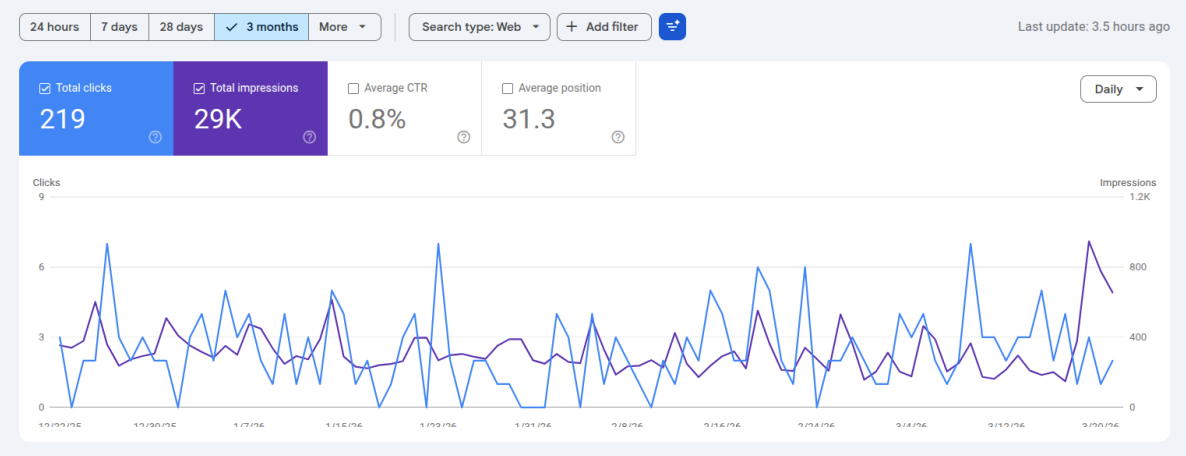
What do the numbers mean?
These numbers are honest, and honesty means saying plainly that they are still early. An average position of 31.3 means the site usually appears well beyond the first page of Google results, and a click-through rate of 0.8% means fewer than one in a hundred impressions turned into a click. Those are not strong numbers on their own, and this case study does not pretend otherwise.
What makes this SEO results case study worth writing is the starting point. Three months earlier, the site had no clicks, no impressions, and no visibility at all. The change from zero to 219 clicks and 29,000 impressions is real, even though the position and the click-through rate show how much headroom is left.
It helps to read the numbers the way Google defines them. In Search Console, a click is a time a user clicked the site from Google Search results, and an impression is a time the site appeared in Search results. The click-through rate is clicks divided by impressions, and the average position is the average position of the topmost result.
What does a 0.8% click-through rate tell us?
A 0.8% click-through rate tells us the site is being seen far more often than it is being clicked. Out of 29,000 impressions, 219 became clicks, which works out to about 0.8%. Fewer than one in a hundred people who saw the site chose to visit it.
That is what you expect when a site sits well beyond the first page. Most people click the results they see first, and a site at an average position of 31.3 is rarely seen first. The low rate is not a separate problem from the low position. The two numbers describe the same situation from two sides.
What does an average position of 31.3 tell us?
An average position of 31.3 tells us the site usually appears well beyond the first page of Google results. The first page holds the top ten results, so a site averaging 31.3 is typically showing up on the third or fourth page, where far fewer people look.
Average position is the average of the topmost result’s position across searches, as Google defines it. It is an average, so some searches place the site higher and some lower, but the middle of the range sits far from the first page.
What does ‘still early’ actually mean?
“Still early” means the site has gone from nothing to visible, not from nothing to strong. Three months of steady work built the foundation, and the foundation is real, but the rankings that bring steady clicks are still ahead.
It also means the numbers should be read as a starting point, not a finish line. A site that was invisible three months ago and now earns 219 clicks and 29,000 impressions has proven the work can move it. What it has not proven yet is how fast it can climb, or how far. Those answers come from the months ahead, not from this case study.
How did Rank OG measure progress from zero?
With no baseline, the only honest way to measure was against zero. At the start there was nothing to compare against: no clicks, no impressions, no position. The first sign of progress was simply that the site began to appear in search results at all.
After that, the four numbers in the screenshot became the record for this SEO results case study. Impressions showed the site was being seen, clicks showed people were choosing to visit, and position and click-through rate showed where the site really stood. Each number answers a different question, and none of them means much on its own.
What can other businesses learn from this SEO results case study?
The first lesson is to fix the site before chasing rankings. A site in a really bad state will waste the work that follows it, and no amount of content can make up for pages that search engines cannot reach or visitors cannot use.
The second lesson is that steady work beats a single big change. This site did not jump from zero to 29,000 impressions in a week. It got there by doing the same three things well, week after week: clean on-page SEO, technical fixes, and content written for real search intent.
The third lesson of this SEO results case study is to read the numbers honestly. An average position of 31.3 and a 0.8% click-through rate are not strong numbers, and this case study does not pretend they are. What they show, read next to a starting point of zero, is real progress with a long way to go.
Three more case studies on this site show the same steady work on other websites: 308 clicks from Google in three months, zero online presence to 29,600 impressions in one month, and 59 clicks and 20,200 impressions in 28 days.
What comes next?
Next comes more of the same steady work. The site needs to keep climbing from an average position of 31.3 toward the first page, and it needs to turn more of its impressions into clicks. That happens the same way the first three months happened: by fixing what breaks, by keeping pages clean and technically sound, and by writing content for real search intent, optimized for Google and AI search. There is no promise about how fast that will happen, only the same steady work that produced the first three months.
The work also keeps the site readable for AI search, so it can be cited as an answer by answer engines and shown by generative engines, not only ranked as a link.
Want the same steady work for your website?
If your website is starting from zero, or stuck where nobody can find it, Rank OG can do the same steady work for you: fix what is broken, then build visibility week after week, with honest numbers at every step. Start with a free consultation, or get a free SEO audit to see where your site stands, then place your order today.
Last reviewed: November 2026.

Frequently asked questions
How long did it take to go from zero to 29,000 impressions?
It took three months of steady work. The site started with no clicks, no impressions, and no visibility on Google at all, and it was in a really bad state. Fixing what was broken came first, then clean on-page SEO, technical fixes, and content written for real search intent.
What does an average position of 31.3 mean?
It means the site usually appears well beyond the first page of Google results. That is still early, and it shows how much headroom is left. The result matters because the site started from zero, so reaching 31.3 in three months is real progress, with a long way to go.
Why is the click-through rate only 0.8%?
Because the site usually appears well beyond the first page, where fewer people click. A 0.8% rate means fewer than one in a hundred impressions turned into a click. That is normal for early results, and it shows the next job: climb toward the first page.
What work was done on the website?
First, what was broken was fixed, because the site was in a really bad state. Then the steady work began: clean on-page SEO, technical fixes, and content written for real search intent, optimized for Google and AI search. That work was repeated week after week, with no shortcuts.
Is this result typical for every website?
No. Every website starts from a different place, and results depend on the starting point and how steady the work is. This case study shows what happened for one website over three months: an honest record of real numbers, not a promise of the same result.
Sources
- Performance report (Search results): Overview and basic setup, Google Search Console Help
Sources checked November 2026.