Brand Mentions AI Search: 6 Powerful Ways to Earn Trusted Citations
By Istiak Ahmed Soikot, Founder and CEO, Rank OG.
Last reviewed: November 9, 2026.
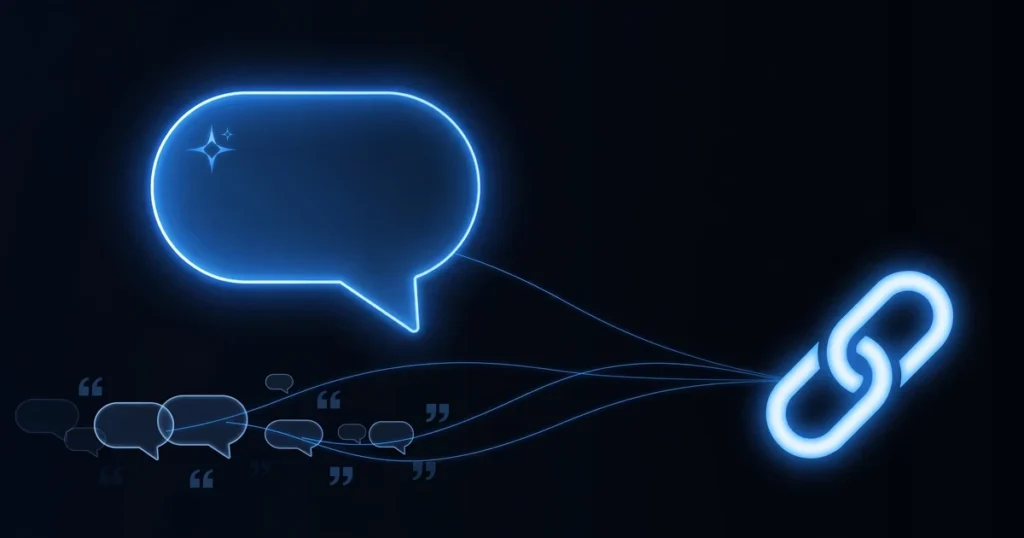
Brand mentions AI search links how the web talks about your brand to how AI answers name and cite you. A mention puts your name in the answer, while a citation adds a link to your page. Here are six ways the two connect.
This guide is for business owners and marketing leads who already rank on Google but rarely show up when buyers ask ChatGPT, Perplexity, or Gemini for a recommendation. You will learn how mentions and citations differ, how the two connect, and which fixes to make first. For the bigger picture, see our guide to AI search optimization.
What Is the Difference Between a Brand Mention and an AI Citation?
A brand mention is your name in an AI answer with no link attached, while an AI citation is a link to one of your pages shown as the source for a claim. You can earn one without the other, so track them as two separate numbers.
A mention puts you on the shortlist: the brands named in the answer become the brands worth a closer look. A citation goes further and gives the reader a clickable path to your page.
Classic rankings are a third thing. A ranking puts your page in a list of links, while a mention and a citation live inside the answer itself. That gap matters for brand mentions AI search: a brand can rank well yet stay invisible in AI answers.
How Does Brand Mentions AI Search Actually Work?
Brand mentions AI search works through retrieval. When you ask a question, the engine searches the web, pulls passages from pages it can reach, and writes an answer grounded in those passages. Your brand shows up when the pages it retrieves keep naming you for that kind of question.
Google explains this in its own guide to generative AI search. Its AI Overviews and AI Mode pull from the same Search index and ranking systems as regular search, using retrieval-augmented generation. The engine also breaks a question into related sub-questions, a step Google calls query fan-out.
ChatGPT and Perplexity run their own retrieval instead of using Google’s index. Perplexity searches the web for every question and writes an answer with numbered citations. OpenAI documents a separate crawler, OAI-SearchBot, that surfaces websites in ChatGPT search results.
There is a second path. When an engine answers from what it learned in training, without searching the web, it can name your brand from memory and show no link. Mentions shape what the model already believes about your category.
How Does Brand Mentions AI Search Turn Mentions Into Citations?
Mentions and citations are not the same job, but they feed each other in six clear ways. Work through them in order, and each one makes the next easier.
1. Mentions put your brand on the shortlist
AI engines answer category questions by repeating the brands their sources keep naming. If your brand rarely appears on the pages an engine retrieves for your category, it has little reason to name you, and no page of yours can get cited for a recommendation you were never part of.
2. Mentions on other sites give engines something to cite
Most AI citations point to pages you do not own: roundup lists, review platforms, news stories, forum threads, and videos. Recommendations lean on what others say about you, so a mention on a respected third-party page does double duty: it names your brand on a page the engine can link to as proof.
This is where brand mentions AI search rewards real coverage: someone else chose to include you. See our guide on how to get cited by Perplexity.
3. Consistent mentions build trust through corroboration
One mention proves little. The same claim repeated across independent sources proves a lot. When several unrelated pages describe your brand the same way, an engine can treat that agreement as a sign the claim is reliable. Google calls trust the most important part of E-E-A-T.
Keep the fix simple: use the same brand name, description, and service list everywhere, so brand mentions AI search can tie them to one brand.
4. Mentions in reviews, forums, and lists reach the pages engines read
Google says its AI features can show what is being said about products and services in blogs, videos, and forum discussions. Those are the places buyers go to compare options, and a forum answer, a customer review, or a listing can become the passage an engine quotes.
Our local citations guide and our Gemini guide cover this ground for brand mentions AI search in local results and Google’s AI answers.
5. One clear brand definition makes mentions easy to match
Engines match mentions to brands by name and by context. If your brand is called one thing on your site, something shorter on social media, and something else again in a directory, the mentions scatter. Write one brand definition and use it word for word wherever a profile asks for a description.
Put the same definition in your Organization schema, so brand mentions AI search has one canonical version to match.
6. Citable pages turn a mention into a link
A mention opens the door, but only a citable page walks through it. When an engine has named your brand, it still needs a page to link to for the claim it is making. That page wins when it answers the question near the top, in a short passage the engine can lift without editing.
Brand mentions AI search favors pages built this way: one passage, one question, one clear answer.
How Do Mentions, Citations, and Rankings Compare?
Each signal does a different job for your business. Treat them as a chain, not as rivals.
| Signal | What the reader sees | What earns it | What to track |
|---|---|---|---|
| Mention | Your brand name in the answer text | Other sites naming you for your category | How often, and on which engines, you are named |
| Citation | A link to your page as the source | A clear, citable passage on an indexed page | Which pages get cited, and for which questions |
| Ranking | Your page in the classic results list | Strong SEO: content, links, and technical health | Positions and clicks in Search Console |
The chain runs left to right. Mentions get you named, citations turn the naming into traffic, and rankings keep the system fed. That is how brand mentions AI search works as a chain.
What Should You Fix First on Your Own Site?
Start with access: a blocked crawler ends the story before it begins. Check your robots.txt and make sure OAI-SearchBot and PerplexityBot are allowed. OpenAI states that sites opted out of OAI-SearchBot will not be shown in ChatGPT search answers. Perplexity recommends the same for PerplexityBot.
Creating content that people find unique, compelling, and useful will likely influence your website’s presence in generative AI search in the long run more than any of the other suggestions.
Google Search Central, Optimizing for Generative AI Features
Then check the basics Google lists: the page must be indexed and eligible to show with a snippet, or it cannot appear in AI Overviews or AI Mode. These are the basic brand mentions AI search checks for any site. Put the direct answer near the top of each important page, and skip llms.txt files and special AI markup, which Google says are not needed.
How Can You Tell If Brand Mentions AI Search Is Working for You?
Google now gives you a direct view. The Generative AI performance report in Search Console shows how often links to your site were shown in AI Overviews and AI Mode, by page, country, device, and date. Google rolled it out to all websites worldwide on August 31, 2026. It reports impressions only, with no clicks or query data yet.
Track brand mentions AI search with a simple prompt panel. Once a week, ask each engine the questions your buyers actually type, and note whether your brand is named, where it sits in the list, and whether a link to your site appears. Test more than once, because citation presence changes between runs, and watch for referrals from Perplexity and ChatGPT in your analytics.
What Should You Avoid When Chasing Brand Mentions?
Do not buy the mentions. Google warns that seeking inauthentic mentions across the web is not as helpful as it might seem, because its spam systems feed its AI features too. Paid listicles, fake forum posts, and bought reviews can put your brand in front of an engine for the wrong reasons.
Skip the other shortcuts too. Do not build thin pages aimed at every fan-out variation of a question: Google treats content made mainly to manipulate rankings or AI responses as scaled content abuse. That is the honest limit of brand mentions AI search. No engine guarantees a citation.
What Should You Do Next?
Work the six brand mentions AI search connections in order, and give each one a week before you judge it:
- Check robots.txt and confirm OAI-SearchBot and PerplexityBot can reach your site.
- Write one brand definition and use it word for word on every profile and listing.
- Pick five buyer questions and check whether your brand is named in the answers today.
- Fix the pages that should answer those questions, with the direct answer near the top.
- Earn one honest third-party mention, such as a review or a list placement, and record where it appears.
Frequently Asked Questions
Do brand mentions help AI search if there is no link?
Yes, they help. A mention puts your brand name in the answer even when no link follows, which puts you on the buyer’s shortlist. That is why brand mentions AI search starts with being named, not being linked. Steady mentions across independent pages shape which brands get named.
Can I get cited by AI search without ranking on Google?
Sometimes, yes, but it is harder. Google’s AI features draw on its Search index, so an indexed page that answers well can be cited even from a modest ranking. ChatGPT and Perplexity run their own retrieval, so a clear page on a smaller site can win there too.
How long does it take for brand mentions to show up in AI answers?
There is no fixed timeline, and no engine publishes one. A new mention must first be crawled and indexed, then retrieved for a relevant question, which can take days or weeks. Crawler changes take about 24 hours to register. Track your prompt panel weekly and look for a slow trend.
Should I block AI crawlers like GPTBot?
It depends on what you want to block. GPTBot controls potential use of your content for model training, while OAI-SearchBot controls whether your site appears in ChatGPT search answers. You can block GPTBot and still allow OAI-SearchBot, but check your robots.txt first.
Do I need special schema or an llms.txt file for AI citations?
No. Google states that no special schema markup is required for its AI features, and that it does not use llms.txt files for Search. Keep using structured data for rich results, since that still helps in regular search. Spend the effort on unique, useful content and citable passages instead.
Sources
- Optimizing for Generative AI Features on Google Search, Google Search Central
- Overview of OpenAI Crawlers, OpenAI
- Perplexity Crawlers, Perplexity
- Generative AI Performance Report (Search), Google Search Console Help
Sources checked November 2026.
If your brand is missing from the AI answers your buyers read, get a free SEO audit. We will map your brand mentions AI search gaps: crawler access, brand consistency, and your most citable pages, then tell you plainly which of the six connections needs work first.